
Duty Free
Seven year cycles, grief, and shaking loose

The stripe of grey hair that frames my face is getting wider, and my historic mastery of remembering people’s names is starting to falter. Things around here are changing. I once read that the cells and tissues in our bodies are replaced every seven years. Upon further research, this turns out to be mostly true. This means that I have an entirely new set of cells and tissues that will never know my mother, who died over seven years ago.
It’s just one way of marking the time since I lost her, and it makes me sad to realize that this iteration of my body will not know her the same way every younger version of me did. At the same time, I have noticed that the way I miss her has changed recently - moving from a constant dull ache, to occasional sharp waves. That means that more of my time is spent without aching, but the waves are painful when they hit. They come on unexpectedly and often take my breath away. They can crash over me when I walk past a restaurant that I once went to with her, or when I hear a piece of gossip that only she would care about.
My son Jacob and I were waiting for an elevator the other day, and he said that he liked the space we were standing in because it reminded him of visiting her. All of a sudden I was overwhelmed with missing the foyer outside my mother’s apartment. How many hundreds of times did I apply Bonnie Bell kissing potion in that hallway on my way to middle and high school? How many chats did I have with my mom while she waited with me for the elevator to get to the tenth floor? In that moment with Jacob I felt like I couldn’t bear that I would never chat with her again, never look in that mirror again. But I did bear it, because what else is there?
I can’t imagine that these waves will ever go away - although I did not think that the daily pain of missing her would ever ease. Until my cells and tissues or heart and brain shift again, I will ride these waves, just as the people I pass while walking down the street are riding their own waves of grief.
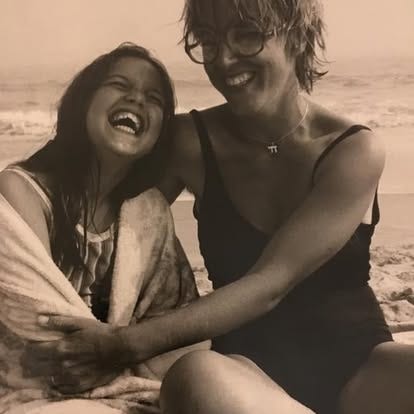
The span of time since my mother died is about to bump up against my daughter Tessa’s college graduation. Tessa will join her brother in their new state of post-college life. And my job will change a bit too. I will always be a mother, and I will always be a daughter - but the physical and temporal demands of each are lighter than they used to be. This leaves me disoriented as I reconsider how I structure my days. A friend once told me that I seem to be motivated by duty, which is not how I understood myself to be moving. I have thought about the word a lot since she said it, and I think it may be true that a sense of duty is so deeply ingrained in me that I don’t recognize it - it is just my default. The dictionary calls duty ‘ a force of moral obligation’: the obligatory tasks, conduct, service, or functions that arise from one’s position (as in life or in a group).
Doing one’s duty is not always (usually?) a bad thing, but it does not necessarily lead the doer to living free. I think that I have often applied that layer of moral obligation when it wasn’t needed, and probably was not helpful. I don’t think that the actions I have taken out of a sense of duty are wildly different from what I would have chosen for myself, but do I think my life would have felt better if I had allowed myself to choose those actions, instead of feeling them as imperatives.
I would have chosen to spend most of the time that I did with my mother, and my kids, but maybe not all of it. I would have chosen a lot of the work I have done, people I have hung out with, emails I have answered - but maybe not all of them.
What would the cost have been if I had not ‘done my duty’? How would I have used that extra time, that bit of extra energy? I can’t know that, but I can allow myself to feel some excitement about this next seven years of new cells and tissues. Will it be different? We will see - it will be harder for me to know what to do and how to be. It requires more thought and self-confidence for me to figure out and then act on what I want to do, rather than to follow what I should do.

I wish I could have had a relationship with my mother that was free of that sense of duty, and I hope to have that with my kids (and to free them from duty too). And with my work, and my body, and my beliefs.
If you watch this far out video made by NPR’s Skunk Bear, you will learn that our fingernails are brand new every six months, and our outer layer of skin every few weeks. Different parts of our bodies are living new lives within our one big life. Free the fingernails!
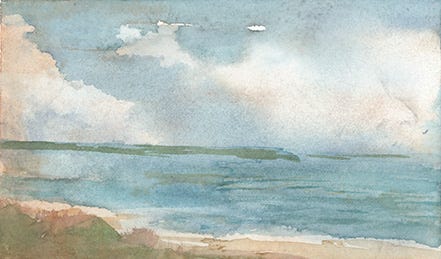
I want to have Maria’s tiny landscapes in all of my lives…
It's been so long since my parents (your grandparents) died that I can barely remember life with them. I do not actively miss them, but Polly Cowan does now and then reach out across the great divide to speak to me. She always has. Her voice rings clear and true in my mind.
That may sound woo woo, but the very last conversation we had before she died suddenly was about how she planned to come talk to me even after she was dead. She was like that.
Nice piece, Lisa. I love reading your essays.
This feels so true it almost aches. I’ve been sitting with that same question—the difference between a life lived in duty and one lived in choice. When I was caring for my parents, “duty” gave me something solid to stand on, but it also carried a silent heaviness, like I was answering a call I hadn’t fully chosen. When I step back and look at my life in fragments though —daughter, partner, mother, builder, daughter again—I kind of see a different pattern. Not obligation, but purpose, constantly reshaping itself. The universe doesn’t hand it to us cleanly. It’s messy, uneven, sometimes it even feels like failure. But there was meaning in showing up for each version of my life as it asked something different of me. I think that’s the shift you’re circling: maybe the actions don’t change as much as we imagine—but the ownership of them does. Duty says “you must.” Purpose whispers “this is yours.”
There’s a kind of freedom in that, but also a kind of vertigo. When the “shoulds” fall away, what’s left is quieter—and requires more courage to trust.
I’m really moved by how you’re standing in that question instead of rushing to answer it.